Seattle stinging insect activity peaks between July and October as ambient temperatures rise across maritime microclimates. Common species include the western yellowjacket (Vespula pensylvanica), the aerial baldfaced…
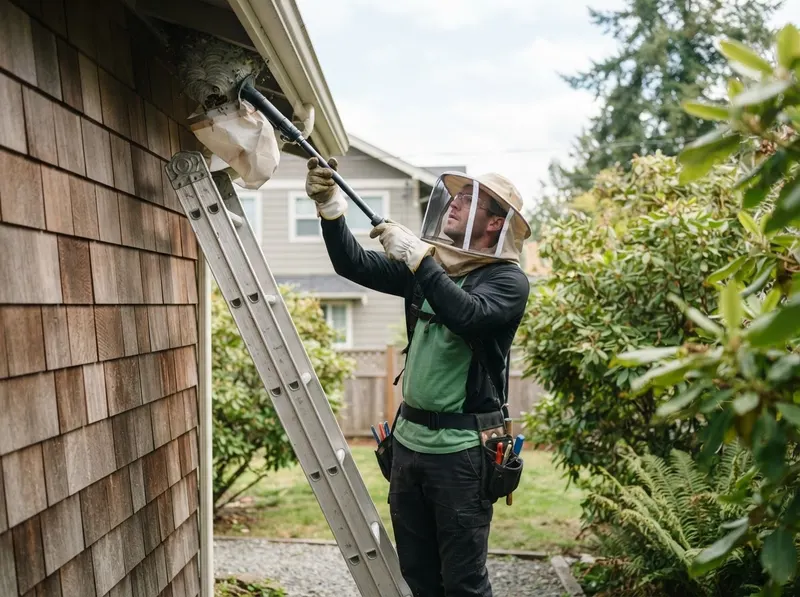
Seattle stinging insect activity peaks between July and October as ambient temperatures rise across maritime microclimates. Common species include the western yellowjacket (Vespula pensylvanica), the aerial baldfaced hornet (Dolichovespula maculata), and the invasive European paper wasp (Polistes dominula). According to the Washington State University Extension, ground-nesting yellowjackets often colonize abandoned rodent burrows under damp cedar landscaping, whereas paper wasps suspend hexagonal combs beneath the open eaves of Craftsman residences in Queen Anne, Wallingford, and Fremont. Identifying whether a colony occupies a landscape void or an exterior architectural soffit dictates the specific extraction protocol required.
Structural nest incursions into interior wall cavities require surgical non-invasive methods rather than indiscriminate insecticide spraying. The US EPA Integrated Pest Management guidelines prioritize targeted mechanical removal and harborage reduction to preserve indoor air quality. If stinging insects penetrate siding gaps into wall insulation near bedrooms, sealing the exit hole prematurely forces aggressive workers inward through drywall electrical fixtures. The trade-off between treating an exterior entry point and performing an immediate structural wall tear-out involves balancing finish repair expenses against the immediate safety risk to occupants. The Public Health - Seattle & King County agency notes that severe allergic reactions to insect venoms represent serious medical emergencies, making immediate isolation of active nesting zones critical.
Environmental protection standards shape nest neutralization strategies near Seattle waterways. Properties bordering Puget Sound in Magnolia and West Seattle, or freshwater basins near Green Lake and the Ship Canal adjacent to the Seattle Parks and Recreation system, must adhere to strict chemical runoff limits established by the Washington State Department of Ecology. Ironleaf Exterminating avoids broad-spectrum pyrethroid fogging that threatens aquatic macroinvertebrates and beneficial native pollinators. Adhering to the pollinator protection frameworks outlined by the Xerces Society for Invertebrate Conservation, professional assessments first verify that the specimens are not beneficial honeybees (Apis mellifera) or native bumblebees (Bombus). True honeybee swarms require non-lethal extraction and rehoming with local apiculturists certified through the Washington State Department of Agriculture.
Long-term defense depends on physical exclusion tailored to damp Pacific Northwest architectural wear. Coastal rain promotes fascia rot and caulking failure around trim boards in older housing stock throughout Ballard, Capitol Hill, and Columbia City. The International Association of Certified Home Inspectors reports that unscreened attic vents and soffit separations serve as primary colonization corridors. Following nest deconstruction, technician protocol applies durable stainless steel mesh and non-silicone architectural sealants certified to building envelope standards supported by the National Association of Home Builders. Technicians operate under protective equipment standards established by the Occupational Safety and Health Administration to safely execute removals at significant heights without driving aggressive insects into neighboring properties. For straightforward scheduling, call (253) 648-3797 or text a photo for a quote.
Every job gets a firm, written price after a free on-site visit.
For standards, safe disposal, and service guidance on PEST CONTROL SEVICE in Seattle, WA, useful references include U.S. EPA, ENERGY STAR, U.S. Dept. of Energy, Consumer.gov, U.S. Census Bureau, and Google Maps. General consumer and small-business resources are available from USA.gov, Better Business Bureau, FTC Consumer Advice, U.S. Small Business Administration, and Ready.gov.
Tell us about your stinging insect nest removal job in Seattle and we'll send a clear, written quote, usually the same day.
 Ironleaf Exterminating