Sub-structural spaces across King County experience severe moisture loading from persistent rainfall and maritime humidity. When Norway rats or house mice penetrate foundation vents or rim joists around neighborhoods…
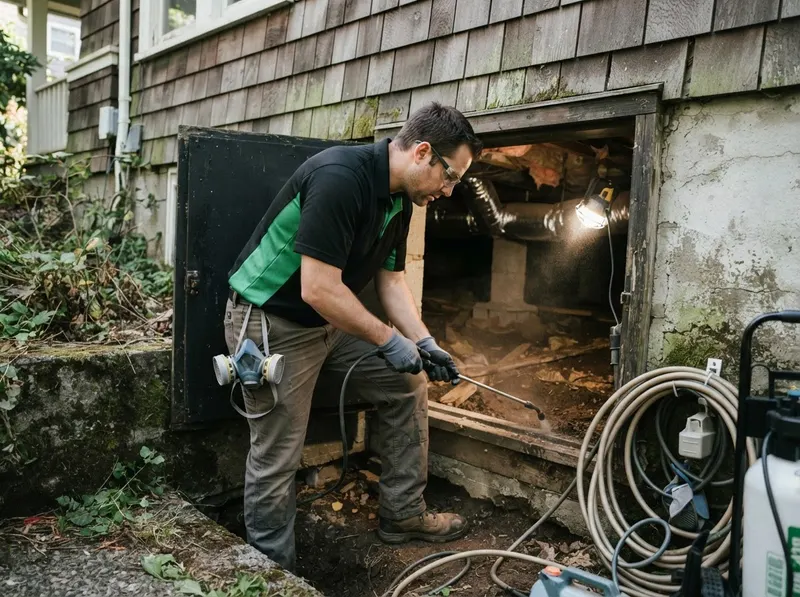
Sub-structural spaces across King County experience severe moisture loading from persistent rainfall and maritime humidity. When Norway rats or house mice penetrate foundation vents or rim joists around neighborhoods like Ballard, Fremont, and Queen Anne, they nest inside fiberglass floor insulation and deposit pheromones across the soil cover. This biological accumulation generates ammonia fumes and distributes aerosolized particles through the floorboards via building stack effect dynamics detailed by the U.S. Department of Energy. A technical crawlspace restoration replaces contaminated materials with modern barrier systems that protect baseline indoor environmental health.
Crawlspace remediation follows a strict sequence to prevent contaminant drift into the living area above. 1. Technicians isolate access points using plastic poly-containment and negative-air HEPA scrubbers conforming to OSHA respiratory protection guidelines. 2. All rodent-soiled fiberglass batting is bagged in heavy contractor sleeves and removed through exterior hatches rather than living areas. 3. Specialized vacuums collect droppings and nesting debris off bare ground, concrete footings, and sill plates. 4. Exposed wooden floor joists receive a non-corrosive, botanical-derived disinfectant recognized under the EPA Biopesticide Program, eliminating pathogen loads without off-gassing synthetic chemicals into interior rooms. 5. A continuous 10-mil or 12-mil polyethylene membrane replaces the torn 6-mil construction sheeting, overlapping seams by 12 inches and staking into soil per the Washington State Energy Code.
The service incorporates rigorous structural exclusion to protect the investment. Crawlspace cleanout without structural sealing results in re-colonization within months because rodents follow scent trails back into unprotected void spaces. Technicians seal mudsills, pipe penetrations, and access doors using heavy-gauge hardware cloth and high-density foam, meeting rodent-proofing specifications outlined by the Centers for Disease Control and Prevention. Unvented and damp foundations common in older homes across West Seattle and Columbia City receive particular focus around the ledger board and post pads, coordinating clearances under the Seattle Residential Code.
Long-term moisture management dictates whether insulation should be rehung immediately. In damp maritime conditions near Green Lake or Discovery Park in Magnolia, soil relative humidity frequently exceeds 80%, raising subterranean moisture levels above thresholds outlined by the Public Health - Seattle & King County Healthy Housing guidelines. If joists register moisture content above 18% on a wood moisture meter, reinstalling subfloor fiberglass traps moisture against the subfloor, encouraging wood-decay fungi like wet rot as monitored by the Washington State University Extension. Technicians deploy structural drying or recommend closed-cell rim-joist sealing complying with Building America Solutions to ensure framing timbers dry fully before new thermal boundaries are set.
Every job gets a firm, written price after a free on-site visit.
For standards, safe disposal, and service guidance on PEST CONTROL SEVICE in Seattle, WA, useful references include U.S. EPA, ENERGY STAR, U.S. Dept. of Energy, Consumer.gov, U.S. Census Bureau, and Google Maps. General consumer and small-business resources are available from USA.gov, Better Business Bureau, FTC Consumer Advice, U.S. Small Business Administration, and Ready.gov.
Tell us about your crawlspace cleanout and sanitization job in Seattle and we'll send a clear, written quote, usually the same day.
 Ironleaf Exterminating